Wednesday, 28 March 2012

Sew Curvy Studio - progress

Hello! It's my weekly (?) pop up from the dust, and painting in Sew Curvy Cottage .. here are some progress pics so far ...

A friend has acquired this Edwardian drop arm mini sofa and is recovering it for me

The bathroom needs cheering up ALOT, so i'm going with a retro rockabilly theme - the blind is made, the leopard skin is to cover a mirror frame.  

I've bought many tea set trios for tea and cake :)

In between it all, there has been a little portfolio design work

The Sew Curvy Shop is fully operational again after a one day move

Colours are being chosen

More china trio's and a vintage picnick basket - what more could we ask for?  Sunshine .. oh yes .. that too.

So - it's all go!  The EXCITING news to which my title refers, is that I will soon be doing another AMAZING giveaway with Dragonfly Fabrics.  Go on.... have a sneaky peek at their summer fabrics now, because you'll have some deciding to do soon ...

Monday, 19 March 2012

Corset makers road trip - Symington re-visited


Well it's been a bit of a whirlwind since I signed up to the studio, but something that had been planned for a long time was a corset makers meet up which happened last Friday/Saturday. It was SUCH FUN!

Imagine, a whole 48 hours of non stop sewing chat ... no glazed looks, no secret or stifled yawns, no inappropriate comments, no polite nods .. just pure, unadulterated, enjoyment of the subject matter and the freedom to talk with abandon knowing that we weren't boring anyone by talking about corsets and sewing!
And so it was that I and three lovely and very talented corset making friends met up and went to Leicester to see corsets, and costumes, and to attend a talk all about .... Yes! Corsetry!!

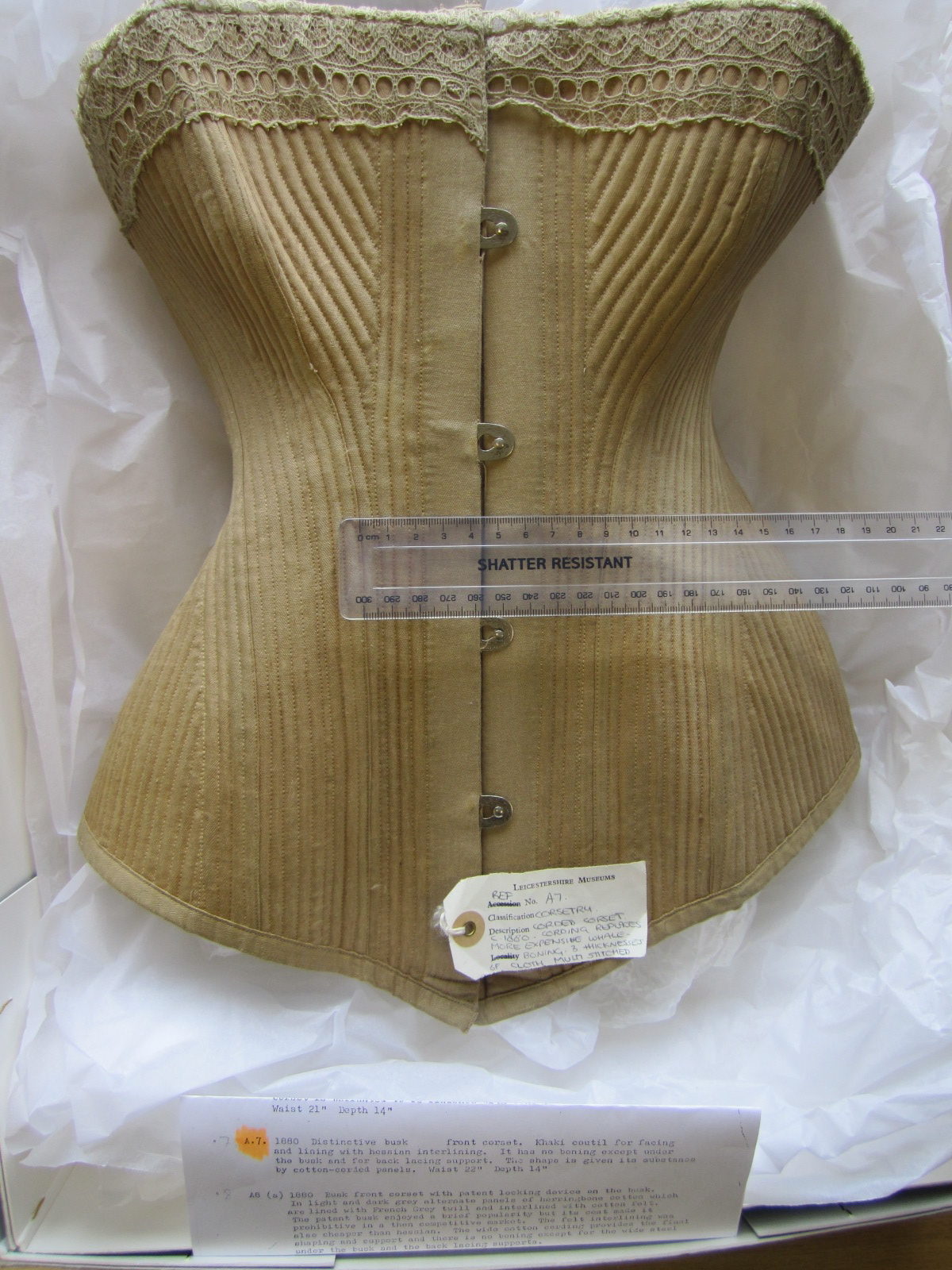
Leicestershire County Council, I'm sure i've mentioned before, owns the world famous Symington Collection of Corsets - the biggest collection of antique corsets in the world. If you want to see it, you can ... for free! All you need do, is book an appointment and you too can get up close and personal with them. On Friday, we had booked such an appointment at their "Resource Centre" and after a tour around the many shelves containing box upon box upon box of corsets, bras, girdles, etc dating from the mid 19th century right up to the present day,  and rail upon rail upon rail of 'costume' from every era including one item from every Next collection that ever was, we got to see some corsets we'd picked out as particularly interesting for our work.

A floral brocade, early Edwardian corset with gorgeous flossing detail
Why don't they make suspender clips like this anymore?
A very delicate and lightweight corset is from 1912
It never ceases to amaze me, how small and delicate these corsets are - this one has incredible shape and hardly any boning at all, the body is entirely supported by cording - string pulled through all of those channels.  But the best thing about this corset is the beautiful shaping.
As I mentioned, in addition to the corset collection, Leicestershire museum also have a huge 'costume collection' containing interesting and beautiful pieces from every era and by many famous couturiers from Vivienne Westwood to Theiry Mugler and everyone before and in between.

Many couture dresses employ corset technology for their foundations.  On Saturday we attended a talk by Jill Salen and Sarah Nicol of the museum, which was all about 'antique corset construction'.  The talk was very informal and hands on, and we were able to examine personally, many couture pieces ...

This Dior dress was exquisite!  Made from beaded tulle and ruched silk, it was a very structured piece with a heavily boned foundation

Utterly gorgeous!
An exquisite dress by John Cavanagh, with strapless foundation and cups
There were fascinating details on this dress, not least the methods by which this outrageously opulent trim was applied.
Modern corsetry to examine, made by the keeper of special collections after much examination of the beauties in her care.
All in all, a fab weekend and one to be repeated as soon as possible!  However, by Sunday it was back to the grind - moving all my stuff over from home to the Sew Curvy Cottage .. more news on that to follow!

Note from the future:  This road trip was with Jenni Hampshire, Alison Campbell and Gerry Quinton.  The original 'fab four' who only the following year would conceive and put together the first Oxford Conference of Corsetry now in it's third year and an internationally renowned event where corset makers from all over the world gather to geek out together!


Wednesday, 7 March 2012

Sew Curvy Cottage - the beginning


Lordy, I haven't posted for ages ... The last few weeks have been an utter whirlwind. You know i've taken on a new studio, well today I went to 'measure up' in advance of getting the keys ... Here's some pics...
Add caption
This is the lovely front door. I'm thinking of painting it green so that when I hold workshops I can say that we're all "having fun behind the green door" hehe!!


Here is the 'front room'.  I am hoping that we can get the fireplace working. There is no heating!  Behind here is a little kitchen and loo.


Upstairs there are two rooms.  This one is the smaller room and it will be Sew Curvy HQ.  Lots of storage/shelving etc., Much bigger than my spare room at home which is the current HQ.


This is the bigger room which will be used for workshops.  The big cutting table will go in here, along with 5 other tables and all my vintage sewing machines!

I get the keys next week when cleaning/painting and arranging will follow in a frenzy!  I'll post progress pics for you as we go. 


Wednesday, 22 February 2012

How to cut silk on the straight grain

This is a very nifty trick I learned over the summer - how to cut silk on the straight grain so that you don't waste any by going in wiggly lines trying to cut it by eye.

First of all, you snip the selvedge at the point where you need to ..


Then, you pull the two sides apart very gently until you have a prominent thread from the weft which runs perpendicular to the selvedge edge.


Pull this thread until it gathers the fabric into a pucker - like when you do a gathering stitch - continue until the whole width of fabric is puckered, like this ... then, pull the fabric straight again.


You'll be left with a visible line in the fabric where your thread has broken the weave of the fabric.  If you hold it up to the light, you can see that the thread is missing.

held up to the light the line becomes much clearer

Then all you do is cut along the line and voila! You have fabric cut on the grain, with no waste. All nice and tidy.

I haven't tried this with cotton so can't tell you if it works or not, and you do get different effects with different silks.  The above example is a standard dupion, and below is some heavy spotty silk..  It also works an absolute treat with fine floaty silks which are nigh impossible to cut straight by eye!


Monday, 20 February 2012

Learning corsetry - the easy way

Thanks for all your lovely comments on my last post, both here and in my personal mailbox :)  I have had many opportunities over the years, but none of them feel quite as right as this one!

As one of the most constant questions I am asked via Sew Curvy is "when's you're next workshop?" I thought i'd better grab the bull by the horns as it were, and schedule some in without delay, now that I have a dedicated space.  I advertised these on Friday night, and already 6 of 16 places are sold!


The first course is about patterning a traditional Victorian style mid/overbust style corset.  You can read the full details by following the link below.  Basically, we'll cover the measuring, how a corset works, the corset block, creating a pattern and fitting said pattern.

The second course scheduled in May will be how to construct a corset using professional techniques.  Those who have been on the patterning course will already know about fitting and can use their own pattern, but those who have not will still learn a great deal about corsetry and how to make a professional looking shape altering garment.  Full details below.

I will be scheduling other workshops of my own, and the rest of the time I may let the workshop space out as a 'sewing salon' for drop in crafters who need to hire a dedicated sewing/cutting space.  I'll have vintage machines to use, a little shop, tea and coffee on tap, and possibly the odd cake or two.


If you are a tutor of something crafty, and need some space to run your own workshop, then do please get in touch with me.


Thursday, 16 February 2012

A room of one's own .. or three!


I have some amazing news Dear Readers ... it's all happened ridiculously fast!    So fast, that this time last week, I wouldn't have dreamed that i'd be writing this post today ... A little tiny bit of background..

2 years ago, I became aware of a litte cottage studio in the woods near me - it's on an estate and part of a larger art studio complex.  The studio was occupied by a successful curtain making business and although I thought that it would be perfect for me one day, I never thought it would ever become available... I would look through the windows wistfully, imagining the possibilities, and then spend idle moments on the interweb looking for a similar set up - ofcourse, nowhere was quite so perfect, infact nothing compared, but I held the dream.

6 months ago, I was told that this little cottage may be coming up for rent, but I ignored this because I thought i'd never be able to afford the rent.   Then a few weeks ago, I was involved in a very exciting online conversation with some corset making friends.  I can't tell you about that but it was one of those conversations of such amazing magnitude  that it can't fail to inspire all those involved and it  gets you thinking in different ways, and then before you know it, your other half is making encouraging noises about similar projects - and so it was with me and Mr Marmalade last week.  Actually, he looked at me in my spare room studio and said  in the nicest way "you've got to get out"...

On Monday, I called the agent who looks after the cottage studio and guess what ... it is still available after 6 months of being 'on the market' and the rent is much more reasonable that I'd imagined. It's as if it really was waiting for me -  here it is:


And guess what?  I went to see it yesterday - it's so perfect for my plans! It has a room downstairs, plus a kitchen, and it has two larger rooms upstairs.  This morning I sent off the deposit and I move in mid-March.  Sew Curvy is expanding!

After we've tarted it up inside, there will be my own dedicated sewing space, an HQ for the Sew Curvy shop, a 'salon' for my private clients, and most exciting of all, a big, light, workshop space where I shall teach people all about the wonders of corsetry and dressmaking!  So there we have it .. a real "House of Marmalade"

I am still in a daze, but stay tuned for progress reports!

Wednesday, 8 February 2012

How to use a thimble

Do you or don't you?  Use a thimble that is...


I didn't used to, but now I can't sew without one.  I've tried over the years to use a thimble because it looks sensible and 'professional' and frankly, I think it looks grown up - but try as I might, every time I put one on, I felt like I had grown at least 2 more fingers which felt horribly cumbersome and clumsy and made any sort of hand stitching physically impossible - talk about being 'all fingers and thumbs'!

The trouble is, that when sewing corsets it's really difficult to stitch certain parts and embellishments without severe injury and so I had to find a way to protect my poor punctured fingers!   Learning to use a thimble was the only option.  After searching in vain for information on how to do this, I thought i'd write my own guide..

An adjustable thimble which allows for long nails!
First of all, you need to find a thimble that fits properly. Thimbles come in different shapes and sizes, some without tops, some without sides, plastic or metal, adjustable -  others have ridges on the top, some are smooth or rounded and some are made of leather.  You can even get 'thimbles' which are nothing more than a metal or plastic disc which you glue onto the pads of vulnerable fingers.

Despite the huge array of choice much of which I have sampled in my quest to find a thimble which is effortless and easy to sew with, in the end, none of them did the job better than the traditional full metal thimble.  Yes the 'topless' ones look tempting don't they? I have tried the ones in the picture and the 'adjustable' plastic type which has one side missing making it look as if it may be un-noticable to use,  but none of them offer full protection - any finger exposure is at risk of stray needle peforation danger!

There was no option in the end - I had to get to grips with the traditional thimble, and once I'd figured out that size matters this job became a whole lot easier.   I found one made by Prymm, which is 14mm and the perfect size for my middle finger.

Don't buy a thimble unless you can try it on first or already know your size.

A thimble is commonly worn on your middle finger, and needs to be very snug - not so snug that you have to force it on, or feel uncomfortable, but so that it doesn't slip off if you hold your finger upside down.  If your fingers are cold, it may be difficult to hold a normally well fitting thimble on, in which case breath a little steam into the thimble before putting it on (in manner of cleaning a pair of glasses).

Now is the difficult part.  Sewing with a thimble requires you to adjust your hand posture when stitching - this is the key.

You have to bend your middle finger (with the thimble on) into a position so that it rests behind the needle when the needle is pushed into the fabric.  I found this blog post quite helpful in explaining this, although I'm not using a tailors thimble, the posture is similar.

Very difficult to photograph oneself using a thimble!
So you hold the needle between thumb and forefinger (as usual) when you insert the needle into the fabric but your middle finger rests behind the needle and pushes the needle into the fabric after the initial stab.  The eye of the needle comes into contact with the side of the thimble during this action, and if you need a little more force, you can then easily manoeuvre your finger to push the needle further with the end of the thimble which in my case, has a little ridge around the top to stop slippage.

And there you have it .. it takes a few sessions to get into the swing, but I found that not only did my hands not hurt from strain so much when hand sewing - infact they don't hurt at all anymore - it has now become a pleasure to put my thimble on before stitching and unexpectedly,  impossible to sew without one.

So does this tempt you to try thimbling where you'd been put off before?